
TWO:The spring of 1720 was a period of remarkable national prosperity. But "the grand money schemes projected of late," which appeared to the Jacobite Atterbury and others calculated to cement the royal peace and strengthen the foundation[46] of the Government and nation, were destined to produce a very different effect. For the South Sea Bubble was about to burst. In 1711, Harley, being at his wits' end to maintain the public credit, established a fund to provide for the National Debt, which amounted to ten millions of pounds. To defray the interest he made permanent the duties on wine, vinegar, and tobacco, etc. To induce the purchase of the Government stock, he gave to the shareholders the exclusive privilege of trading to the Spanish settlements in South America, and procured them an Act of Parliament and a royal charter, under the name of the South Sea Company. The idea, hollow and groundless as it was, seized on the imagination of the most staid and experienced traders. All the dreams of boundless gold which haunted the heads of the followers of Drake and Raleigh were revived. The mania spread through the nation, and was industriously encouraged by the partisans of Harley. But this stupendous dream of wealth was based on the promises of Ministers, who at the Peace of Utrecht were to secure from the Government of Spain this right to trade to its colonies. The right was never granted by that haughty and jealous Power, further than for the settlement of some few factories, and the sending of one small ship annually of less than five hundred tons. This, and the Assiento, or privilege of supplying those colonies with African slaves, were the sole advantages obtained, and these were soon disturbed by the war with Spain, which broke out under Alberoni. The South Sea Company, however, from its general resources, remained a flourishing corporation, and was deemed the rival of the Bank of England.PIUS IX. QUITTING THE VATICAN IN DISGUISE. (See p. 583.)
THREE:In all those arts which increase the prosperity of a nation England made the most remarkable progress during this reign. A number of men, springing chiefly from its working or manufacturing orders, arose, who introduced inventions and improvements in practical science, which added, in a most wonderful degree, to the industrial resources of the country. Agriculture at the commencement of the reign was in a sluggish and slovenly condition, but the increase of population, and the augmented price of corn and cattle, led to numerous enclosures of waste lands, and to improvements both in agricultural implements and in the breeds of sheep and cattle. During the thirty-three years of the reign of George II. the number of enclosures averaged only seven per annum, but in the first twenty-five years of the reign of George III. they amounted to forty-seven per annum. During that period the number of enclosures was one thousand one hundred and eighty-six, the number each year rapidly increasing. The value of the produce also stimulated the spirit of improvement in tillage as well as enclosure. Many gentlemen, especially in Northumberland, Kent, Norfolk, and Suffolk, devoted themselves to agricultural science. They introduced rotation of crops instead of fallows, and better manuring, and also cultivated various vegetables on a large scale in the fields which before had generally been confined to the garden, as turnips, carrots, potatoes, cabbage, parsnips, etc. Their example began to be followed by the ordinary class of farmers, and the raising of rents greatly quickened this imitation. At the opening of the reign the rental of land did not exceed ten shillings per acre on an[188] average; the rental of the whole kingdom in 1769 being sixteen million pounds, according to Arthur Young, but in a few years it was nearly doubled. This gentleman, who has left us so much knowledge of the agricultural state of the kingdom in his "Tours of Survey," tells us that, northward especially, the old lumbering ploughs and other clumsy instruments were still in use, instead of the improved ones, and that there was, therefore, a great waste of labour, both of man and beast, in consequence. But still improvement was slowly spreading, and already Bakewell was engaged in those experiments which introduced, instead of the old large-headed and ill-shaped sheep, a breed of superior symmetry, which at once consumed less food and yielded a heavier carcase. It was at first contemptuously said by the old race of farmers and graziers, that Bakewell's new herd of sheep was too dear for any one to purchase and too fat for any one to eat. As he was pursuing his improvements in Leicestershire, Culley prosecuted similar ones in Northumberland in both sheep and cattle.The chief seats of the hosiery manufacture are in the counties of Derby, Nottingham, and Leicester. The number of stocking-frames in England in 1821 was under 30,000, showing an increase in thirty years of only 10,000. Mr. Felkin gives an estimate for 1833, which states that there were 33,000 frames in England, producing 3,510,000 dozen stockings a year, and consuming 8,137,000 lbs. of cotton yarn, worsted, and silk, valued at ¡ê814,000; the wages for making them amounting to ¡ê948,000, and for finishing, ¡ê229,000; the total value being little short of ¡ê2,000,000 sterling, and the total value of the materials ¡ê560,000. The total number of persons employed in the making of stockings was 73,000. The total of fixed capital engaged in the manufacture was ¡ê385,000, and of floating capital ¡ê1,050,000. The quantity of cotton hosiery goods made in 1833 was estimated by Mr. Felkin to have increased more than fifty per cent. in the preceding twenty years.
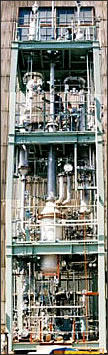
High quality is being demanded in many fields nowadays and so in order to satisfy that we developed a high-purity distillation system in collaboration with Ube industries, Ltd. and Kanto Chemical Co., Inc. The system is used to refine cleaning solutions for the semiconductor industry, medical materials, etc. of high purity (residual ion concentration: 0.01 to 1.0 ppb).
- Our High-purity distillation system provide our clients with high solvent recovery rate, almost 100%.
- The quality of the products/output from our system is very stable, which makes production management very easy, and easier than the conventional ion exchange resin method.
- No emission of waste brings our clients reduction of running cost for environmental measures.
- Our various devices minimize entrainment.
- To prevent the elution of metal, you could ask us the system made of Teflon.
- Our High-purity distillation system has been already proved for solvents that trigger very rapid decomposition reactions, such as hydrogen peroxide.
- Product guide
- Alcohol distillation
- Distillation equipment
- High-purity distillation system
- Membrane separation type solvent dehydration system
- Reactor
- Evaporative concentration equipment
- Coulter spray dryer
- Microwave treatment system
- Filter dryer
- OS filter (continuous vacuum rotating filter)
- Hydrocyclone (liquid cyclone)
- Thermal oil heater (heat medium boiler)
- Process air heater (air heater)
- Ammonia treatment system
- Catalytic deodorizing equipment for ammonia and VOC gas
- Stationary cryogenic storage tank
- Portable cryogenic container
- Cryogenic liquefied gas evaporator